Description
BPC-157 TB-500 Blend Description
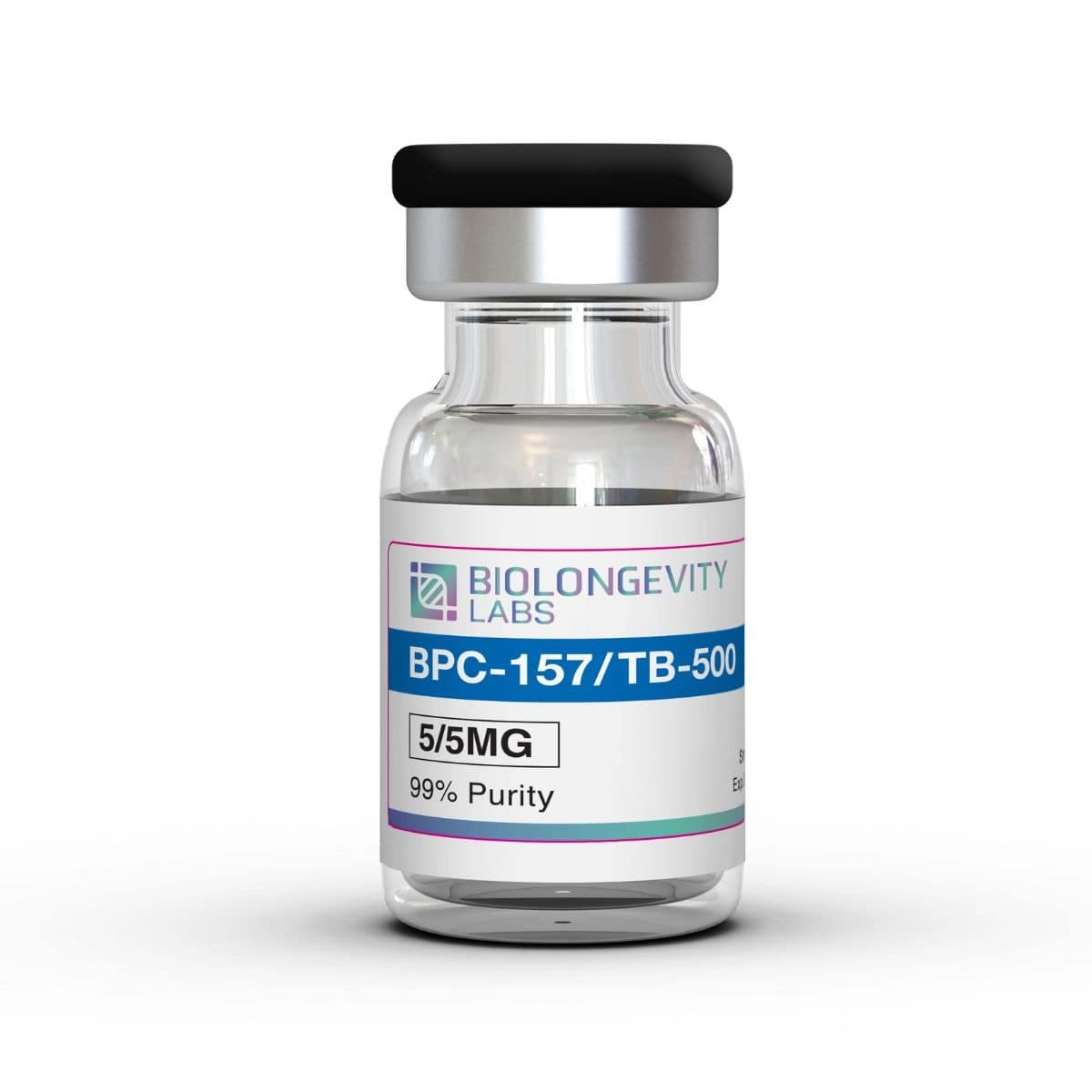
The BPC-157 TB-500 Blend is a premium research peptide formulation that combines two of the most extensively studied peptides in regenerative science. By pairing BPC-157 (Body Protection Compound-157) with TB-500 (a synthetic Thymosin Beta-4 fragment), this blend enables researchers to investigate complementary cellular pathways involved in tissue repair, angiogenesis, inflammation modulation, and musculoskeletal recovery.
Experimental research also suggests that BPC-157 may influence nitric oxide signaling, growth factor activity, and angiogenic pathways involved in wound healing and tissue remodeling.
TB-500 is a synthetic analogue of the active region of Thymosin Beta-4, a naturally occurring peptide involved in cell migration and tissue regeneration. Laboratory studies have examined its ability to regulate actin dynamics, promote cellular movement, support angiogenesis, and assist in connective tissue remodeling across multiple experimental models.
Because these peptides act through distinct biological mechanisms, researchers frequently investigate them together to explore potential synergistic effects. While BPC-157 primarily focuses on growth factor signaling, vascular support, and inflammatory modulation, TB-500 is studied for its influence on cytoskeletal organization, cellular migration, and tissue remodeling. Their complementary actions make this combination valuable for research into musculoskeletal recovery and regenerative biology.
Each vial contains a total of 10 mg of peptide, consisting of:
- BPC-157 – 5 mg
- TB-500 – 5 mg
BPC-157 TB-500 Blend Benefits
Laboratory studies continue to investigate the BPC-157 TB-500 Blend for its potential role in:
- Tissue repair and regeneration research
- Tendon and ligament biology
- Muscle recovery studies
- Wound healing mechanisms
- Collagen synthesis and extracellular matrix remodeling
- Angiogenesis and microvascular development
- Cellular migration and proliferation
- Inflammation pathway modulation
- Joint and connective tissue research
- Gastrointestinal tissue studies
- Endothelial function and vascular biology
- Soft tissue recovery models
Research Applications
The BPC-157 TB-500 Blend is commonly utilized in laboratory investigations involving:
- Regenerative medicine
- Musculoskeletal biology
- Sports recovery research
- Connective tissue physiology
- Cellular signaling pathways
- Angiogenesis research
- Orthopedic tissue models
- Inflammation and wound healing studies
BPC-157 TB-500 Blend Effects
The BPC-157 TB-500 Blend combines two research peptides that act through different but complementary biological pathways. BPC-157 is primarily studied for its effects on angiogenesis, nitric oxide signaling, and fibroblast activity, while TB-500 is investigated for its role in cell migration, cytoskeletal remodeling, and tissue regeneration. Together, they are frequently researched to better understand coordinated tissue repair and recovery mechanisms.
Current laboratory and preclinical research suggests the blend may influence:
- Accelerated tissue repair by supporting multiple phases of the healing process.
- Enhanced angiogenesis, encouraging the formation of new blood vessels that deliver oxygen and nutrients to damaged tissues.
- Improved collagen production and extracellular matrix remodeling, supporting connective tissue integrity.
- Increased fibroblast migration and proliferation, which are essential for wound closure and tissue regeneration.
- Support for tendon and ligament healing through activation of cellular repair pathways.
- Muscle recovery and regeneration, particularly following injury or mechanical stress.
- Joint and connective tissue remodeling by promoting cellular organization and repair.
- Modulation of inflammatory pathways, helping researchers study balanced inflammatory responses during tissue healing.
- Improved endothelial and microvascular function, supporting healthy circulation within injured tissues.
- Enhanced cell migration and cytoskeletal organization, allowing cells to efficiently move to areas requiring repair.
- Support for gastrointestinal tissue integrity, making the blend valuable in studies of digestive tract healing.
- Potential synergistic regenerative effects, as the two peptides target separate biological pathways involved in tissue restoration.
How the Blend Works
Researchers are interested in this combination because each peptide contributes differently to the repair process:
- BPC-157 is studied for activating VEGFR2, nitric oxide signaling, FAK-paxillin pathways, angiogenesis, and fibroblast function.
- TB-500 is investigated for regulating actin dynamics, promoting cellular migration, stimulating tissue remodeling, and supporting angiogenesis through cytoskeletal mechanisms.
Because these mechanisms are largely complementary rather than overlapping, the blend is commonly used in regenerative research to examine whether coordinated activation of vascular repair and cellular migration leads to improved tissue healing compared with studying either peptide alone. However, combination-specific human clinical evidence remains limited, and most available data comes from laboratory and animal studies.
BPC-157 TB-500 Blend Dosage
The BPC-157 TB-500 Blend is commonly investigated using subcutaneous administration in laboratory research. Because this blend combines equal amounts of BPC-157 and TB-500 in a single vial, each dose delivers both peptides simultaneously. There is currently no standardized or FDA-approved dosing protocol for this combination, and research methods vary between studies.
Common Research Protocol
- Typical daily dose: 500–1,000 mcg of the total blend per day.
- This provides approximately:
- 250–500 mcg of BPC-157
- 250–500 mcg of TB-500
- Administration: Subcutaneous injection.
- Frequency: Once daily.
- Research cycle: Commonly 4–8 weeks, followed by a washout period before beginning another research cycle.