Description
MOTS-c Description
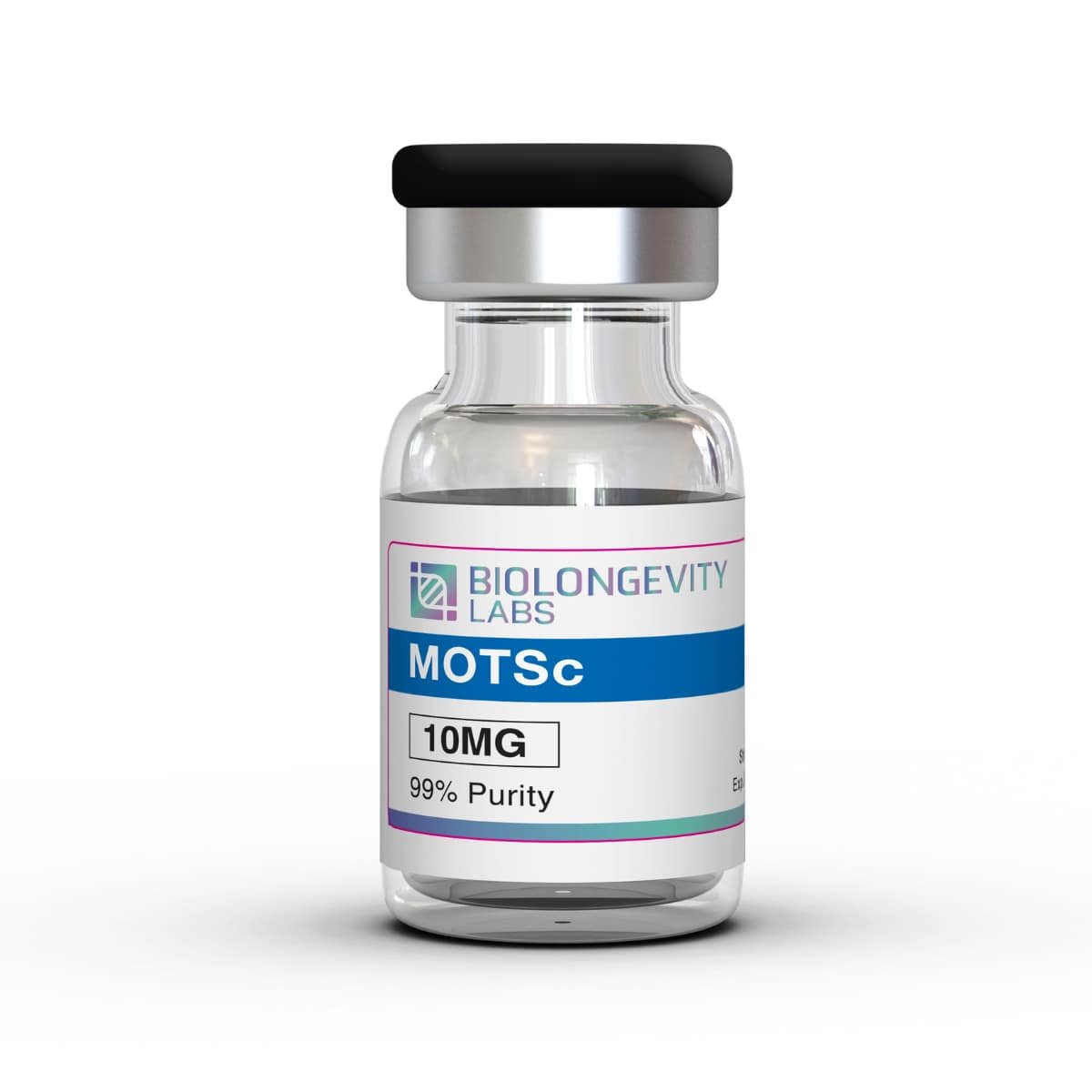
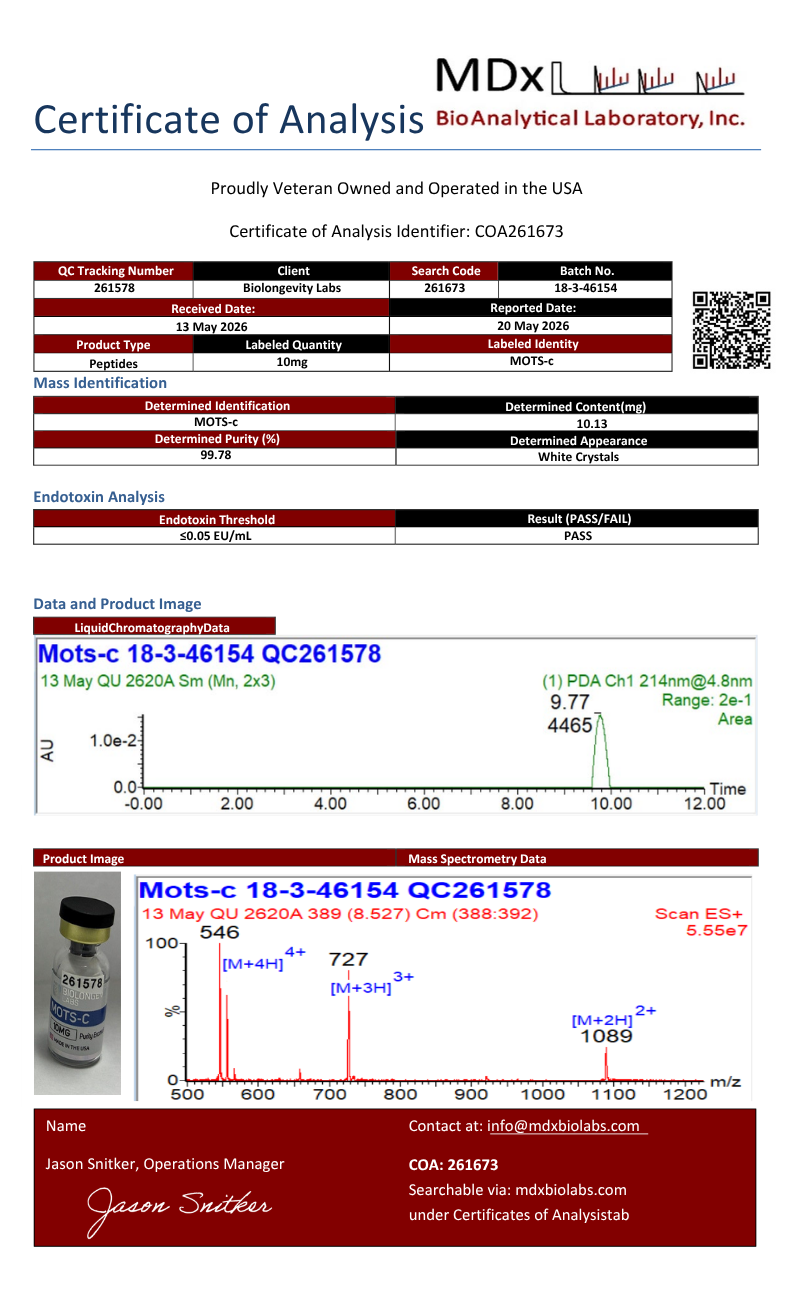
MOTS-c (Mitochondrial Open Reading Frame of the 12S rRNA-c) is a naturally occurring mitochondrial-derived peptide (MDP) first identified in 2015. This 16-amino acid peptide is encoded within the 12S rRNA region of the mitochondrial genome and serves as an important signaling molecule linking mitochondrial activity with cellular metabolism. Research indicates that MOTS-c is highly active in skeletal muscle, where it helps regulate metabolic processes by activating the AMP-activated protein kinase (AMPK) pathway, a key regulator of cellular energy balance, glucose metabolism, and metabolic homeostasis. Due to its role in mitochondrial signaling, MOTS-c continues to be studied for its potential involvement in metabolic health, insulin sensitivity, exercise physiology, and healthy aging.
Mots-c Peptide Specifications
| Property | Value |
|---|---|
| Peptide Sequence | Met-Arg-Trp-Gln-Glu-Met-Gly-Tyr-Ile-Phe-Tyr-Pro-Arg-Lys-Leu-Arg |
| Molecular Formula | C101H152N28O22S2 |
| Molecular Weight | 2174.6 g/mol |
| CAS Number | 1627580-64-6 |
| PubChem CID | 255386757 |
| Synonyms | 1627580-64-6, UNII-A5CV6JFB78, MOTS-c (human) (trifluoroacetate salt), A5CV6JFB78 |
Mots-c Peptide Dosage Chart
| Parameter | Perfect B Protocol |
|---|---|
| Dose per injection | 5mg (25 units) |
| Number of injections | 4 per cycle |
| Frequency | Once every 5 days |
| Cycle duration | 20 days |
| Injection timing | Night, 2+ hours post-meal |
| Rest between cycles | 4 months minimum |
| Maximum cycles per year | 3 |
The 5-day spacing between injections reflects the pharmacodynamics of how MOTS-c signals at the mitochondrial level. Injecting more frequently does not accelerate the response and is not part of any protocol we prescribe at our Doral clinic.
The Day-by-Day Breakdown
Each MOTS-c cycle consists of exactly 4 injections spread across 20 days, one every 5 days:
| Day | Action |
|---|---|
| Day 1 | Injection 1, 5mg (25 units) |
| Days 2 to 5 | Rest, no injection |
| Day 6 | Injection 2, 5mg (25 units) |
| Days 7 to 10 | Rest, no injection |
| Day 11 | Injection 3, 5mg (25 units) |
| Days 12 to 15 | Rest, no injection |
| Day 16 | Injection 4, 5mg (25 units) |
| Days 17 to 20 | Cycle complete, begin 4-month rest |
Why Are the Injections Spaced Apart?
Some MOTS-c research studies use only a few administrations over several weeks instead of daily dosing. Researchers believe this allows the peptide’s cellular signaling effects to continue between administrations, giving the body time to respond before the next exposure.
Because MOTS-c is still being studied, there is no standardized or approved dosing protocol. Research schedules vary depending on the goals of each study, and further clinical research is needed to determine the safest and most effective approach.
MOTS-c Peptide Benefits
- Investigated for its role in supporting cellular energy metabolism.
- Studied for improving glucose uptake and utilization in skeletal muscle.
- May enhance insulin sensitivity in experimental models.
- Explored for activating the AMPK signaling pathway involved in metabolic regulation.
- Investigated for maintaining glucose homeostasis and metabolic balance.
- Studied for supporting healthy mitochondrial function and cellular communication.
- May regulate nuclear gene expression during metabolic stress.
- Explored for promoting cellular homeostasis under stress conditions.
- Investigated for its potential role in weight management and obesity research.
- Studied for reducing diet-induced insulin resistance in laboratory models.
- May improve exercise performance and endurance by mimicking exercise-induced signaling.
- Explored for supporting skeletal muscle metabolism and function.
- Investigated for its potential role in healthy aging and longevity research.
- Studied for age-related declines in mitochondrial signaling and metabolic health.
- May support cardiovascular health through metabolic and cellular signaling pathways.
- Investigated for protecting vascular and endothelial cell function.
- Studied for its potential anti-inflammatory effects by regulating inflammatory cytokines.
- Explored for reducing oxidative stress in experimental models.
- Investigated for improving cellular stress resistance through mitochondrial-to-nuclear signaling.
- Studied as a potential therapeutic target for metabolic disorders, including obesity and insulin resistance.