
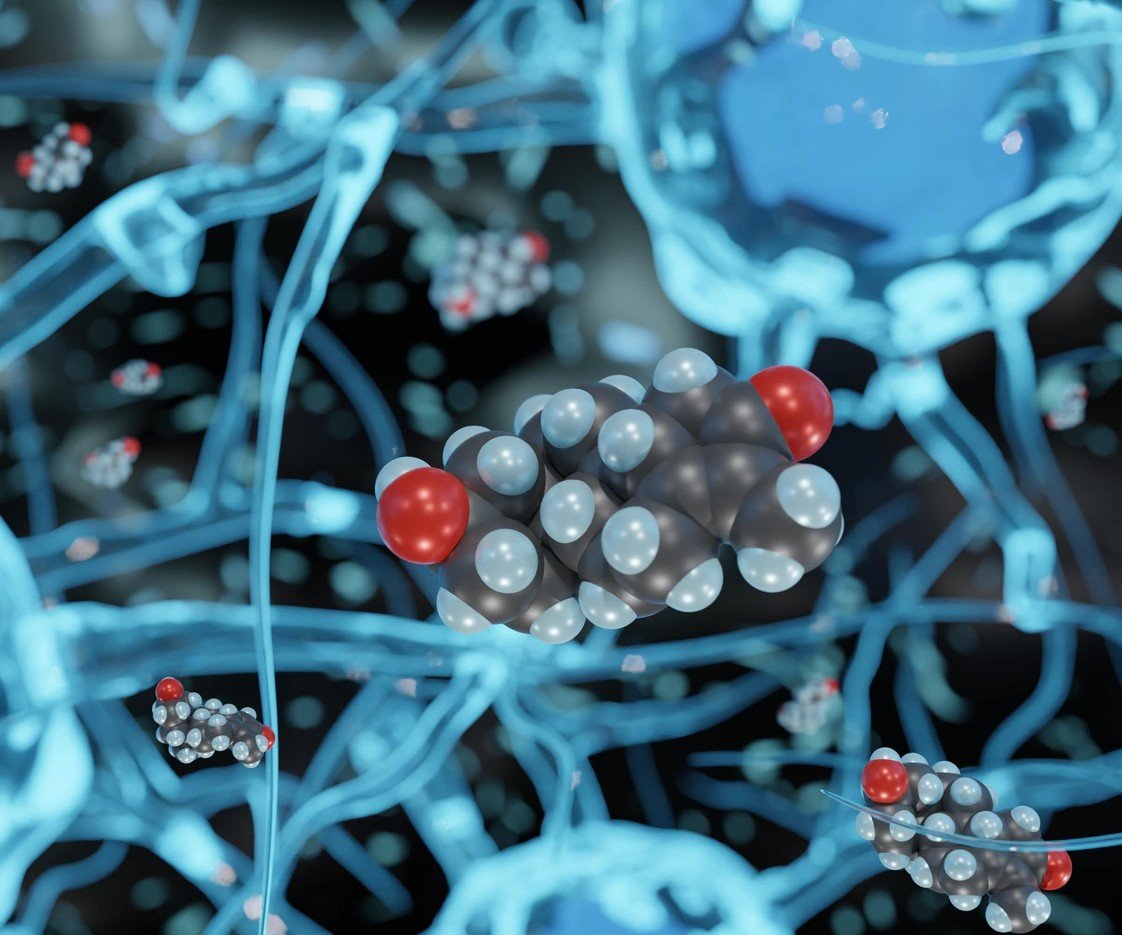
Tesamorelin is a synthetic growth hormone-releasing hormone (GHRH) analog developed for laboratory research involving growth hormone signaling and endocrine regulation. Structurally, it contains the complete 44-amino acid sequence of endogenous GHRH with targeted modifications that improve peptide stability and resistance to enzymatic degradation.
These structural enhancements enable Tesamorelin to remain active longer than native GHRH in experimental models, allowing sustained activation of growth hormone-releasing hormone receptors (GHRHRs) on pituitary cells. Laboratory investigations suggest this receptor activation promotes pulsatile release of endogenous growth hormone (GH), leading to downstream increases in insulin-like growth factor-1 (IGF-1) and activation of anabolic signaling pathways across multiple cell types.
Tesamorelin Structure and Stability
Tesamorelin closely resembles naturally occurring GHRH but incorporates modifications that improve its pharmacological stability during laboratory investigation.
Research indicates that the peptide possesses an experimental half-life of approximately 25 to 40 minutes, substantially longer than endogenous GHRH, which typically remains active for only 7 to 10 minutes. This extended stability is primarily attributed to a trans-3-hexenoyl modification at the N-terminus that reduces degradation by dipeptidyl peptidase-IV (DPP-IV), while C-terminal amidation further contributes to structural integrity.
Because of these modifications, pituitary cells exposed to Tesamorelin demonstrate prolonged receptor activation and sustained growth hormone release under controlled laboratory conditions.
Growth Hormone Receptor Activation
Experimental studies suggest Tesamorelin activates growth hormone-releasing hormone receptors (GHRHRs), members of the Class B G protein-coupled receptor family.
Binding of Tesamorelin appears to trigger conformational changes within the receptor that stimulate Gs protein coupling, leading to activation of adenylate cyclase and increased intracellular cyclic AMP (cAMP) production.
Elevated cAMP subsequently activates protein kinase A (PKA) signaling, promoting synthesis and exocytosis of endogenous growth hormone from pituitary cells. Structural studies indicate that proper interaction between the peptide and extracellular receptor domains is essential for efficient receptor activation.
Tesamorelin and Growth Hormone Secretion
Laboratory investigations consistently demonstrate that Tesamorelin enhances endogenous growth hormone secretion while preserving the body’s natural pulsatile release pattern.
Experimental models have reported increases in both basal growth hormone production and growth hormone pulse amplitude, resulting in significantly greater overnight GH secretion without altering pulse frequency.
Importantly, short-term laboratory studies indicate that these increases occur while maintaining physiological secretion rhythms rather than producing continuous growth hormone stimulation.
Downstream IGF-1 and Anabolic Signaling
One of the primary downstream consequences of Tesamorelin-induced growth hormone release is increased production of insulin-like growth factor-1 (IGF-1).
IGF-1 functions as a major anabolic signaling molecule involved in regulating cellular growth, proliferation, tissue remodeling, and protein synthesis. Research suggests Tesamorelin significantly elevates circulating IGF-1 concentrations, promoting activation of the PI3K/Akt/mTOR signaling pathway, one of the central regulators of cellular hypertrophy.
Activation of this pathway has been associated with:
- Increased protein synthesis
- Enhanced ribosomal biogenesis
- Cellular proliferation
- Skeletal muscle hypertrophy
- Tissue remodeling
- Connective tissue repair
- Osteoblast and chondrocyte activity
- Fibroblast growth
Experimental studies have also reported increases in lean tissue area and improvements in muscle quality following prolonged Tesamorelin exposure in laboratory models.
Tesamorelin and Catabolic Fat Metabolism Research
In addition to anabolic signaling, Tesamorelin has been investigated for its influence on lipid metabolism and adipose tissue biology.
Research suggests that growth hormone released following Tesamorelin stimulation preferentially targets visceral adipose tissue, where growth hormone receptor density is believed to be substantially higher than in subcutaneous fat.
Activation of these receptors appears to stimulate enzymes involved in lipolysis, including:
- Hormone-sensitive lipase (HSL)
- Adipose triglyceride lipase (ATGL)
These enzymes promote triglyceride breakdown, releasing free fatty acids and glycerol that may subsequently undergo β-oxidation for cellular energy production.
Laboratory investigations also suggest activation of JAK/STAT signaling pathways, leading to increased expression of genes involved in fatty acid oxidation while suppressing pathways associated with lipid storage.
Metabolic and Lipid Research Applications
Researchers continue investigating how Tesamorelin-mediated growth hormone signaling influences broader metabolic processes.
Experimental findings suggest reduced visceral adipose tissue may improve lipid handling within liver cells and support healthier lipid metabolism. Laboratory studies have also explored potential changes in:
- LDL receptor expression
- Triglyceride metabolism
- Cholesterol transport
- Hepatic lipid accumulation
- Fatty acid oxidation
- Insulin signaling pathways
These observations continue to make Tesamorelin an important investigational peptide for studies involving endocrine regulation, body composition, metabolism, and cellular growth signaling.
Research Applications
Tesamorelin is widely used in laboratory investigations involving:
- Growth hormone physiology
- GHRH receptor signaling
- IGF-1 production
- PI3K/Akt/mTOR pathway research
- Skeletal muscle hypertrophy
- Protein synthesis
- Cellular proliferation
- Adipose tissue metabolism
- Visceral fat biology
- Endocrine signaling
- Metabolic regulation
- Healthy aging research
For laboratory research use only. Tesamorelin is intended exclusively for scientific investigation and is not approved for human or veterinary use.



2 Comments
John Doe
Vivamus pharetra lacus id lectus sagittis venenatis consectetur sed mauris. Duis sit amet vehicula tellus. Donec sed lacinia tellus. Integer sed massa ut ante placerat mollis. Fusce finibus eget nisl id pretium. Nulla varius auctor iaculis. Vestibulum volutpat nec justo sit amet elementum. Etiam risus tortor, facilisis nec risus sit amet, pellentesque pulvinar sapien.
Bob Brown
Sed maximus felis vel ultrices lacinia. Curabitur ac quam eu risus lobortis malesuada nec sed nisl. In neque purus, vestibulum nec neque a, sollicitudin tempor lacus. Cras scelerisque finibus augue, sit amet tempor augue cursus condimentum. Pellentesque justo erat, placerat vel pharetra vel, hendrerit eget nisl.